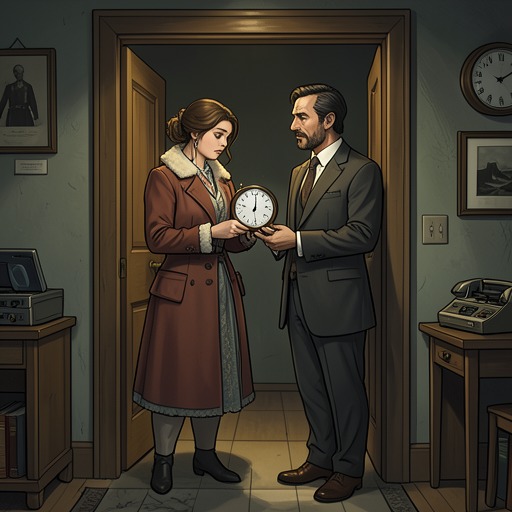
Henry and Clare’s reunion in 2053
The Time Traveler's WifeHenry and Clare’s reunion in 2053 is the novel’s delayed fulfillment of a meeting first disclosed as a glimpse from the future: Henry, displaced in time, finds Clare at eighty-two and takes her into his arms. Its quiet domestic setting makes the encounter a culmination not of time’s defeat, but of a promise carried through absence, aging, and years of waiting.
The future first glimpsed
The reunion enters the story before it happens. In a letter to Clare, Henry recalls being in Kendrick’s waiting room when he suddenly found himself in an unfamiliar dark hallway, tangled among galoshes and smelling rain. At the end of the hall, morning light outlined a door. He looked into a white, sunlit room and saw a woman seated with her back to him, wearing a coral-colored cardigan. When she turned, he recognized Clare as an old woman in the future. He describes the vision as a meeting that seemed to bring him from death to hold her, and says he will leave its details for her to imagine so that the eventual encounter can arrive unrehearsed.
The letter gives Clare more than a promise: it gives her knowledge of a future Henry has already visited, while withholding the scene’s full particulars. He tells her they will see each other again and urges her to live fully in the present. That instruction stands beside the assurance of his return, linking the prospect of reunion to the life Clare must continue in his absence. His closing declaration that time is nothing makes the promise intimate, but it cannot make the intervening years disappear.
Clare’s long expectation
On July 14, 2053, Clare is eighty-two. She rises at dawn, dresses, brushes her hair, makes toast and tea, and sits looking at the lake. The routine resembles earlier periods when Henry was gone and she waited for him, but this absence carries a difference: she has been told he will come eventually. Her expectation does not tell her when the reunion will occur. Instead, it makes waiting part of her daily life, expressed in the repeated acts of getting up, preparing breakfast, and watching the water.
Clare sometimes wonders whether being ready for Henry might prevent the miracle from happening. The thought exposes the uncertainty inside her knowledge: she is sure he is coming, yet she cannot bring him to her through certainty or readiness. She has no choice but to remain where she is, living her ordinary days while holding to what Henry told her. The reunion therefore arrives against a long history of absence, not as an escape from it.
The meeting in the white room
On July 24, 2053, Henry finds himself in the dark hallway he had described in his letter. Galoshes and raincoats fill it; beyond a slightly open door, white morning light enters a room. Inside, an old woman sits at a plain wooden table by a window, a teacup beside her. She faces the lake, where the waves repeatedly rush up the shore and recede. Henry recognizes the woman by her long white hair, coral-colored sweater, and familiar bearing: Clare, now eighty-two.
The reunion unfolds through recognition and movement. Henry shifts his weight, the floor creaks, and Clare turns toward him. Her face changes into joy; she comes to him slowly, and he takes her into his arms. The scene fulfills the earlier vision in its essential details—the hallway, rain gear, bright room, tea, coral sweater, and elderly Clare—but now supplies the encounter the letter had deliberately left for the future. The once-anticipated image becomes reciprocal: Henry sees Clare, and Clare sees Henry.
Fulfillment, not escape
The dates emphasize the unusual shape of the encounter. Clare’s account of waiting is dated July 14, while Henry’s arrival is dated July 24; the two entries present the reunion from different temporal positions. The novel’s dated fragments likewise place scenes from different years beside one another, including their first date in 1991 and Henry’s violent death in 2007. This arrangement makes the 2053 meeting more than a straightforward chronological conclusion: it is a future Henry has already glimpsed and a future Clare has been told to expect, reached only after the years that separate those forms of knowledge.
The reunion does not erase Clare’s waiting or turn it into a brief misunderstanding. Its domestic particulars—tea, a window, the lake, the hallway cluttered with galoshes and raincoats—give the promised return an ordinary physical place. For Clare, the arrival answers the expectation that has accompanied her mornings; for Henry, it completes the visit he remembered from an earlier displacement. The scene closes that distance in an embrace, while leaving the years of lived absence intact. In that tension between certainty and waiting, the meeting gives lasting form to the couple’s attachment across time.